
East Baton Rouge Criminal History Checks
No single parish database answers every criminal-record question. Start with the court that could have heard the matter. The East Baton Rouge Clerk of Court keeps Nineteenth Judicial District Court files, and its Clerk Connect route is account based. Baton Rouge, Central, and Zachary maintain separate city-court records. A common-name match is only a lead until the docket number, date, and another identifier agree.
Then check the record that fits the event. The East Baton Rouge Sheriff’s Office booking list addresses local custody. LA VINE covers later transfer or supervision. For a person’s own statewide repository record, Louisiana State Police BCII uses fingerprints through Right to Review. Bring spelling variants, an approximate year, and any docket or booking number.
An East Baton Rouge search should follow the record from its source. The arresting agency can supply an incident report through its public-record process. EBRSO can confirm a parish booking or route a caller through Inmate Records at 225-358-4000. The East Baton Rouge Clerk of Court supplies district filings and certified outcomes, while each city clerk answers for its own docket. No one office can certify all four records.
When an online route returns nothing, use the counter or records-request fallback. Clerk Connect can require an account, older files may remain archived, and a municipal prosecution will not appear in the district system merely because the arrest occurred in the parish. Ask the custodian to search by case number first. If only a name is known, provide a date range and spelling variants.
- Identify whether the likely case belongs in district court or a city court.
- Match a result by case number and a second reliable identifier.
- Check the parish booking channel for present or recent custody.
- Read the filed charge, minute entries, and final disposition together.
- Order a certified copy or BCII self-review when official proof is needed.
Four East Baton Rouge Custodians
An incident report, jail booking, court case, and repository history are four distinct records. BRPD, EBRSO, Central Police, Zachary Police, campus police, or another arresting agency writes the report. Parish Prison creates the booking file. A court clerk records what prosecutors filed and how each count ended. BCII ties fingerprint-supported arrest cycles to dispositions reported by courts.
| Channel | Best answer | Limit |
|---|---|---|
| Arresting agency | What officers reported | Allegations may be redacted |
| EBRSO booking | Local intake and custody | Not proof of conviction |
| Court clerk | Filed counts and outcome | Separate city and district dockets |
| BCII | Identity-based Louisiana history | Purpose-restricted access |
Compare the court outcome with the arrest entry. A refusal, amendment, dismissal, or acquittal can make records look inconsistent even when each reflects a different stage.
Official Background Checks in Louisiana
The Louisiana State Police Bureau of Criminal Identification and Information maintains the state repository. It does not offer an unrestricted anonymous name search. A person who wants to inspect their own Louisiana record follows BCII’s fingerprint-based Right to Review instructions. Approved agencies use the Louisiana Computerized Criminal History system under purpose and authorization rules.
BCII materials describe a $5 technology fee added to background-check requests and generally cite $26 for approved noncriminal-justice state processing, before federal, vendor, or capture charges. Obtain the requesting agency’s authorization code before using LAPS. The Internet Background Check portal is an authorized-user login, not a public people search.
A clerk search cannot replace a fingerprint-supported repository response, and the repository response does not replace the court file. Fingerprints help tie an arrest cycle to the right identity. The docket is better for reading the bill of information, plea, minutes, judgment, and sentence. An FBI Identity History Summary is another product, limited to fingerprint information reported to the FBI.
BCII Right to Review
Right to Review is the clearest route when a Louisiana rap sheet may contain the wrong person or a missing disposition. Follow BCII’s current identity, fingerprint, form, and payment directions. Compare each arrest cycle in the response with the certified disposition from the court that handled it.
A parish court search and a BCII self-review answer different questions. Use both when correcting a statewide record.
If an East Baton Rouge entry lacks an outcome, request the minute entry or certified final disposition from the proper clerk. The clerk certifies its own file; BCII handles correction of the repository response.
Kinds of Criminal Records
East Baton Rouge criminal records follow an event through several owners. Police reports describe alleged facts and evidence. Parish Prison records document intake, listed charges, bond, and release. A bill of information or indictment states the formal accusation. Court files record pleas, hearings, rulings, disposition, sentence, costs, and appeals.
Other sources serve narrow purposes. City Court publishes selected Baton Rouge warrant data, while the issuing court remains the confirmation source. LA VINE addresses imprisonment and supervision. State Police maintains the registry. Juvenile, investigative, victim, sealed, and expunged material may be confidential.
Baton Rouge City Court updates its open warrant table daily, but warns that processing may take seven to ten days and that a result does not confirm an active warrant. Verify a hit with the court file or City Constable. A district capias may require the 19th JDC clerk or EBRSO, while Central and Zachary bench warrants remain with their municipal courts.
- Incident report: held by the agency that created it.
- Booking record: created by EBRSO after intake.
- Court file: held by the district or municipal clerk.
- Repository history: maintained by BCII.
- Custody entry: found through EBRSO, DPS&C, or LA VINE.
Two Downtown Criminal Dockets
The Nineteenth Judicial District Court and Baton Rouge City Court sit in the same downtown cluster, but their files are not interchangeable. District court handles felony and state-law cases through fifteen divisions. City Court hears city criminal, traffic, and qualifying misdemeanor matters within its jurisdiction. The East Baton Rouge Clerk of Court is custodian of the district case, while Baton Rouge City Court has its own clerk and numbering system.
A BRPD stop can lead to different routes. Many ordinance matters stay in City Court, while a state Title 32 matter or felony prosecution may proceed in district court. Central and Zachary add their own municipal dockets. Ask which court issued the file number before visiting a counter. If the search begins with a citation, read the court printed on it. If it begins with a booking, compare the arrest charge with the later filed count because the prosecutor may amend or decline it.
The 19th JDC courthouse at 300 North Boulevard is the district route. Baton Rouge City Court is at 233 St. Louis Street, Room 310, and its Criminal and Traffic counter lists weekday hours of 8:00 a.m. to 4:30 p.m. Confirm current access rules and bring the case or citation number when known.
Note: Justice of the Peace courts are not substitutes for a district criminal-case search.
East Baton Rouge Criminal Records: What They Contain
A court file is organized around a case, a booking file around custody, and a BCII history around identity. Read the source before interpreting a field. The same charge label can be an arrest allegation in one record and a filed count in another.
| Name and identifiers | Names, aliases, birth data, SID or FBI number |
|---|---|
| Arrest and booking | Agency, intake date, jacket number, charges, bond |
| Case and charge | Docket, division, counts, statutes, plea |
| Disposition | Conviction, acquittal, dismissal, refusal, or no-bill |
| Sentence | Confinement, probation, fine, costs, restitution |
| Supervision | Custody, release, probation, parole, or warrant status |
Protected identifiers, victim facts, confidential attachments, and expunged material should not appear in ordinary public results. The final disposition belongs to the court file.
Louisiana terms affect how a result reads. A bill of information is a prosecutor-filed charge. A capias or attachment directs an arrest, often after a missed appearance. An Article 893 or 894 dismissal can follow a qualifying deferred sentence, yet does not automatically erase all public records. Read each label beside later docket events.
Dismissed Does Not Mean Deleted
A dismissal tells how a filed count ended. It does not erase the police report, booking photo, fingerprints, or repository arrest cycle. Louisiana expungement is a separate process that can remove qualifying records from public access. It does not destroy the file.
- Nolle prosequi
- The prosecutor formally stops a charge.
- Acquittal
- A not-guilty result after trial.
- Disposition
- The recorded outcome for a charge.
- Expungement
- Removal from public access with authorized access preserved.
Obtain a certified outcome before drawing conclusions from an old booking entry.
Louisiana Public Access Laws
The Louisiana Public Records Law grants access to existing public records, subject to exceptions. Send the request to the custodian that keeps the file. Police may withhold active-investigation details and redact protected information even when a related court docket is public.
Key Statutes:
R.S. 44:31 creates the access right.
R.S. 44:32 addresses inspection and copy charges.
R.S. 15:587 controls criminal-history dissemination.
A denial should identify its legal ground. The requester can narrow the scope or ask for the segregable public portion.
East Baton Rouge Record Fees
City-Parish copies cost $1 per page for the first ten pages and $0.50 afterward. Audio files cost $30. A flash drive or authenticity affidavit costs $35. Advance payment may apply to larger jobs.
| Item | Amount |
|---|---|
| First ten pages | $1 each |
| Later pages | $0.50 each |
| Audio file | $30 |
| Flash drive or affidavit | $35 |
Describe the account, terms, date range, event, and format. Court copies use the clerk’s process. Ask for an estimate before broad media review.
Restricted, Sealed & Expunged Records
Juvenile files are generally confidential. Active-investigation details, victim or minor identities, medical facts, Social Security numbers, and security information can be withheld. An adult expungement removes a qualifying record from public access rather than destroying it. Justice agencies retain access Louisiana law permits.
Articles 971 through 973 cover the purpose and effect. The definition includes incident information, photos, fingerprints, dispositions, and related failure-to-appear warrants, but excludes DNA. Louisiana also recognizes expungement by redaction, interim expungement, and expedited relief in qualifying cases.
The East Baton Rouge route begins with a certified disposition for every count. Compare the outcome with current eligibility rules and waiting periods. File in the court that handled the case, name the arresting agency and BCII correctly, and ask the clerk for current costs. Diversion or PTI completion is not automatically an expungement order.
District and municipal matters may require different clerk contacts. The motion must identify the agencies that hold related arrest and repository records. After a signed order is processed, check the public court, booking, and repository channels again. A result that remains visible may reflect processing time, a second case number, or material the order did not cover.
- Obtain certified dispositions for every count.
- Check the outcome against eligibility rules.
- File the uniform motion in the court that handled the case.
- Identify every custodian correctly.
- Verify removal after processing.
City-by-City Criminal Records in East Baton Rouge
City police write their own reports, while municipal courts keep assigned city cases. Baton Rouge adds an open warrant dataset. Central separates public-record and crash requests and uses IBTS as custodian. Zachary publishes direct Records contacts and operates a city court at its Police/Court Complex.
Baton Rouge Record Check
BRPD reports, City Court records, and warrant data
Central Record Check
Central Police, IBTS requests, and city court
Zachary Record Check
Zachary Police Records and City Court access
EBRDA Commons Case Flow
The District Attorney links to EBRDA Commons, an aggregate view of local case flow. It helps explain screening, filing, and outcome patterns across East Baton Rouge cases, but it is not an individual docket, a certified outcome, or proof of guilt. A chart may show how groups of matters moved without stating why one named charge ended.
The source image below shows the East Baton Rouge Commons interface.
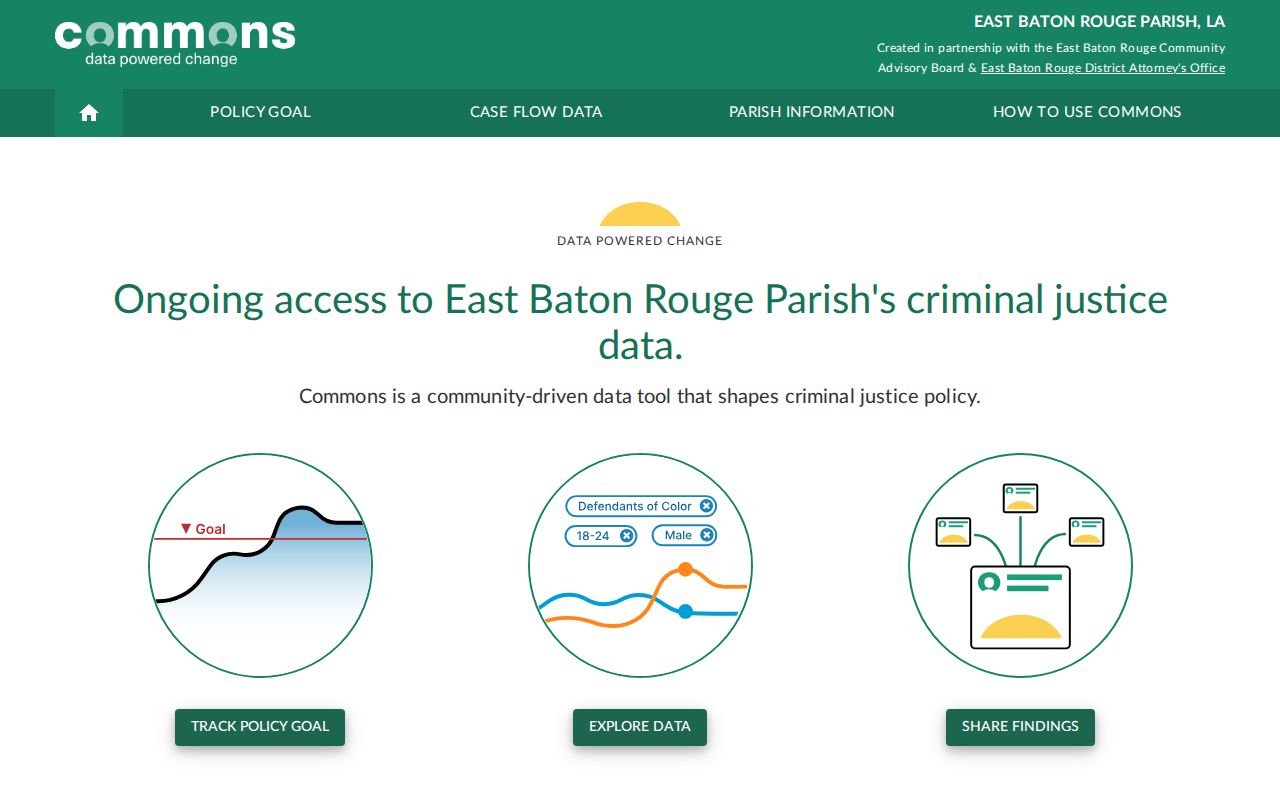
Use the official court file for a named case. Clerk minutes, pleadings, and the disposition provide detail an aggregate dashboard cannot. Commons is most useful for parish system context after the individual record has been verified.
East Baton Rouge Supervision Records
Adult felony probation and parole are state run through the Louisiana Department of Public Safety and Corrections. The Baton Rouge office serves most of East Baton Rouge Parish, but the directory routes several northern communities elsewhere. Confirm the assigned office before sending a request or appearing in person. A court imposes probation, while the state division maintains the supervision relationship.
DPS&C explains the supervision structure and links readers to its office directory.
LA VINE may show custody, transfer, or supervision status. The assigned district office confirms supervision details, while public parole hearing notices and results follow the Board of Pardons and Committee on Parole route.
Louisiana Repository Record Limits
BCII receives data from many offices. Recent court action, an older paper case, a spelling variation, or an unreported disposition can create a gap. Compare the response with the originating court. Municipal matters can be missed when a search starts only with the district clerk. Federal cases require PACER and the Middle District of Louisiana rather than a parish portal.
The BCII page publishes current forms and fee notices.
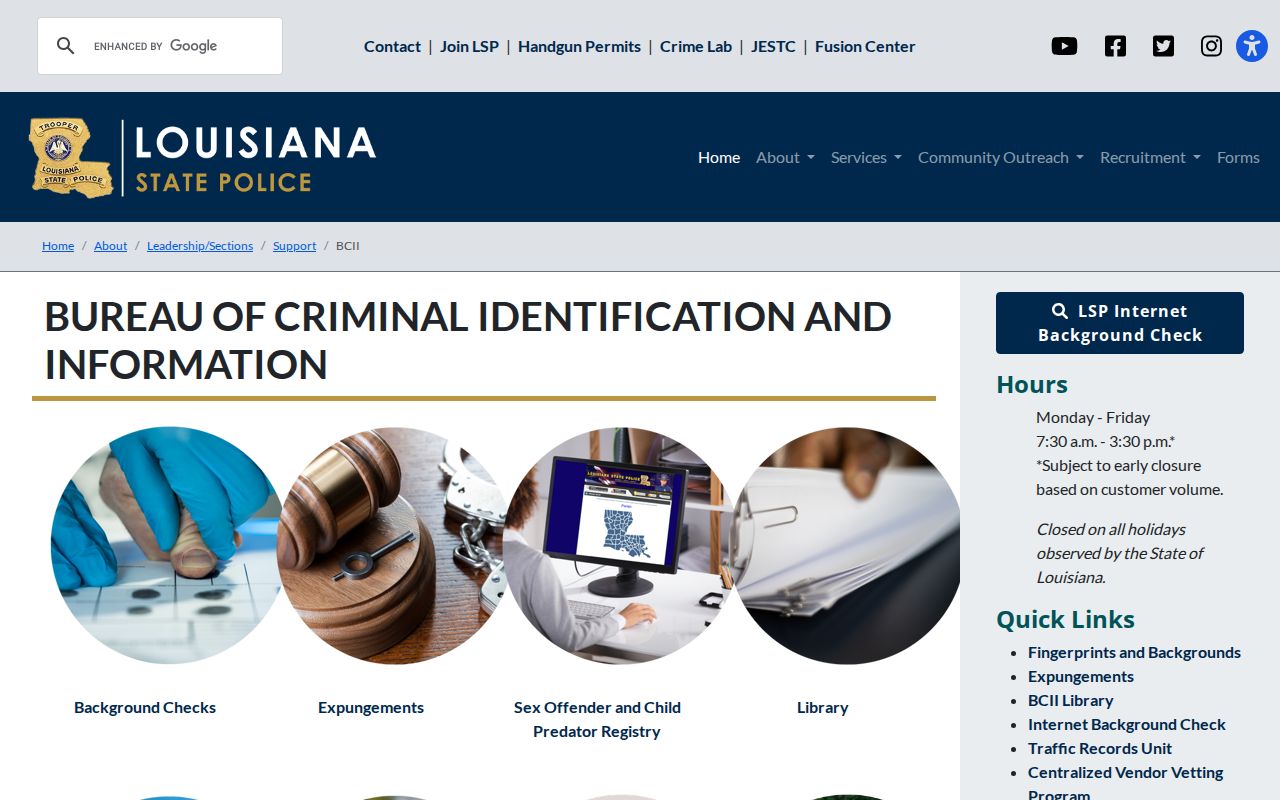
Use those instructions for self-review and corrections.
Records can change on different schedules. Parish custody may update after release while a court minute still shows the hearing that produced it. A prosecutor dashboard may count a screening decision that never becomes a conviction. BCII may wait for a disposition transmission. Record dates and source names therefore matter as much as the person’s name. Save the docket or booking number, note when the search ran, and return to the original custodian for a current certified response.