
Baton Rouge Criminal History Checks
Start with the event and its custodian. BRPD owns its police report, EBRSO owns a Parish Prison booking, City Court owns municipal and qualifying misdemeanor files, and the East Baton Rouge Clerk owns 19th JDC cases.
- Request the BRPD incident report with its number, date, location, and involved person.
- Check EBRSO for a custodial booking and release status.
- Check Baton Rouge City Court for city matters and its separate warrant data.
- Use Court Case Lookup for a district filing and disposition.
- Use BCII Right to Review for your own statewide fingerprint-supported record.
One Arrest Can Create Four Different Records
A BRPD arrest may create a police report, an EBRSO booking, a fingerprint-supported BCII arrest cycle, and then a City Court or 19th JDC case. These systems update separately. A booking proves custody based on a warrant or probable cause; it does not prove conviction. The filed charge and outcome belong in the court record.
Search recent events at the agency and jail first. Use the court file for what prosecutors formally filed and how the judge resolved it. Missing or conflicting entries should be taken to the custodian, not filled with assumptions.
Records at the Baton Rouge Police Department
BRPD holds reports for incidents it investigates inside the city. A focused City-Parish request supplies report number, exact date and time, location, involved person, record type, date range, and delivery preference. Body-camera and 911 requests should identify the officers or call to reduce review scope.
The official BRPD page identifies the agency and current routing.
This police channel is separate from a Parish Prison booking and from the later court file. No verified official app-only records lookup was found.
Make the BRPD Request Specific
The City-Parish form may request contact information, the incident number, date, time, location, involved person, detailed description, date range, inspection or copy preference, certification, attachment, and acknowledgment. Documented fees are $1 per page for the first ten pages and $0.50 thereafter, $30 per audio file, and $35 per affidavit or large-production flash drive.
Active investigations, juvenile and victim information, and other protected material may be redacted. Ask the custodian to identify the applicable exemption when material is withheld.
Audio and Video Requests Need a Narrow Time Window
BRPD body-camera footage and a 911 recording require more precision than a request for a short paper report. Identify the incident number when known, the exact or approximate time, the location, the responding officer or unit, and the call involved. A narrow description helps the City-Parish custodian locate responsive material and determine what review or redaction is required. Broad requests can increase both processing work and media costs, especially when several officers or a long time span are involved.
The City-Parish fee schedule treats media differently from ordinary pages. State whether inspection, an electronic copy, a paper copy, or certification is needed and ask for a cost estimate before authorizing a large production. The police record may still omit active-investigation material, protected victim details, juvenile information, or footage restricted by another law. A redacted release does not mean the corresponding booking or court record is unavailable from its separate custodian.
Booking and Arrest Records in Baton Rouge
A custodial BRPD arrest generally flows to EBRSO Parish Prison. The inmate list reflects current custody, not a complete history. Absence can mean release, transfer, a spelling variation, confidential status, or no custodial booking.
Call Inmate Records at 225-358-4000 when the online list does not settle the question. Then request the BRPD report and follow the case to court. The Arrest Search page covers LA VINE and transferred custody.
Confirm a City Court Warrant Hit
Baton Rouge City Court publishes searchable, downloadable active-warrant data with name, residence fields, race, sex, year of birth, action date, file number, division, and case type. It is updated daily, yet processing can take seven to ten days.
Do not treat downloaded data as confirmation. Verify the file with City Court or call the City Constable at 225-389-3889 or 225-389-3004 before approaching law enforcement.
The Baton Rouge Municipal Court File
City Court is at 233 St. Louis Street, Room 310, and Criminal/Traffic hours are weekdays 8:00–4:30. Created in 1900, it generally hears city criminal, traffic, ordinance, and qualifying misdemeanor matters within its stated jurisdiction. Individual file copies come from the court.
The official court page supplies current contact and jurisdiction details.
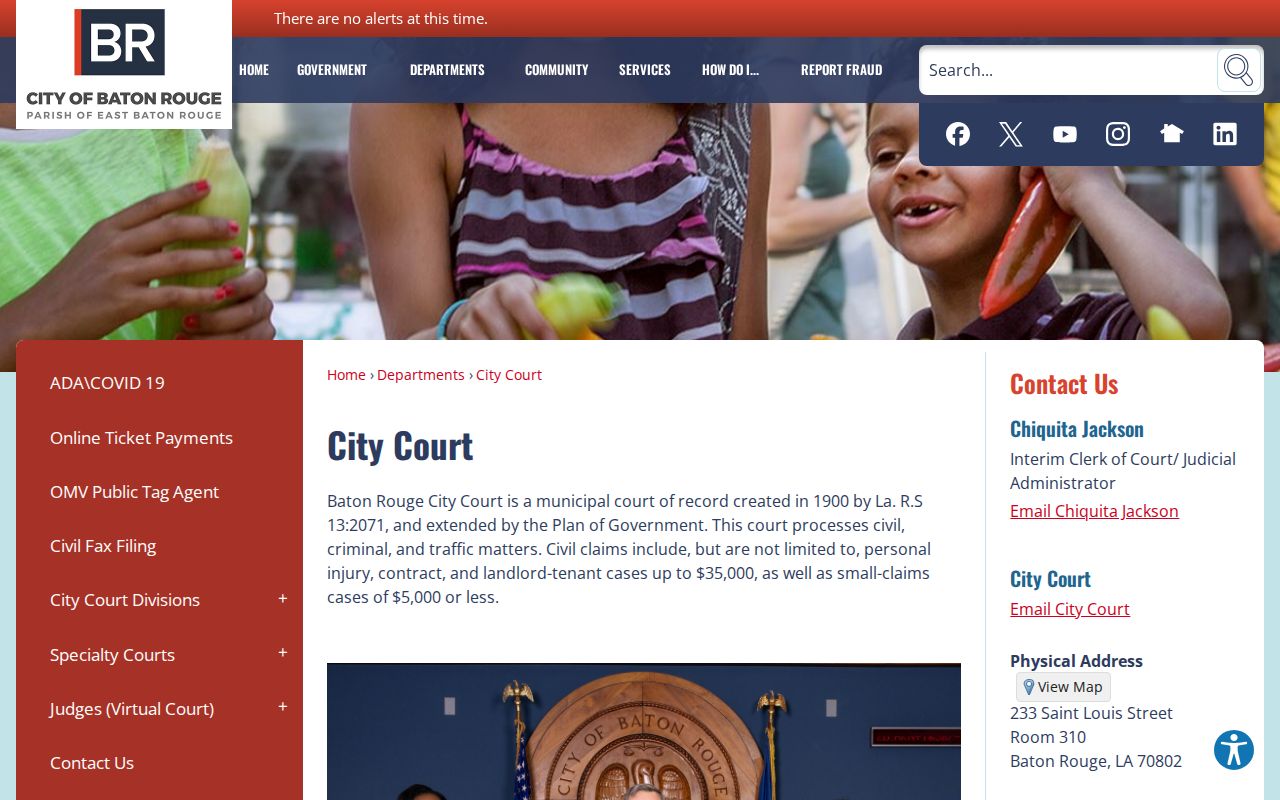
Call 225-389-5279 for the court or 225-389-5278 for Criminal/Traffic. A warrant-data row is not a substitute for the underlying case file.
| Court Name | Baton Rouge City Court |
|---|---|
| Case Types Heard | City criminal, ordinance, traffic, and qualifying misdemeanor matters. |
| Case Lookup Channel | Court counter or Criminal/Traffic contact; open data separately covers active warrants. |
| What the Docket Shows | Charge, settings, judicial events, and disposition as entered. |
| Copies & Fees | Request current copy and certification terms from the court. |
Title 11 Versus Title 32
Many BRPD Title 11 ordinance tickets go to City Court, while state-law Title 32 tickets can be prosecuted by the district attorney in district court. Read the citation’s authority and listed courthouse before concluding that a case is missing. This routing difference is one of Baton Rouge’s most common search traps.
How Baton Rouge Records Reach the County
District cases become 19th JDC files maintained by the East Baton Rouge Clerk. Dispositions should flow to BCII, but paper records and reporting schedules can cause gaps.
Record flow: BRPD › EBRSO Parish Prison › City Court or 19th JDC › Louisiana State Police BCII
Use the agency and jail for immediacy, the court for formal charges and outcomes, and BCII Right to Review for your own statewide record.
Capital-City Jurisdiction Changes the Custodian
Baton Rouge includes BRPD, EBRSO, Louisiana State Police, LSU Police, Southern University Police, and federal authority around government, campuses, interstates, river, rail, and industrial sites. The investigative report remains with the originating agency even if EBRSO handles the booking.
Crime counts also require agency and year labels. A BRPD count from the FBI Crime Data Explorer is not a parish total because other agencies cover separate or overlapping territory.
When a Baton Rouge Matter Reaches the 19th JDC
The Nineteenth Judicial District Court has original criminal jurisdiction at the district level in East Baton Rouge Parish. The district attorney screens arrests and may file a bill of information; a grand jury may return an indictment. Once a district case exists, the East Baton Rouge Clerk of Court is the record custodian. Clerk Connect provides subscription access, while the clerk’s criminal department remains the fallback for files, certified dispositions, older material, and questions a portal result does not resolve.
A police charge and a filed count may differ. Prosecutors can decline a matter, amend the legal theory, or file only some allegations. Later docket entries may reflect a plea, dismissal, trial result, sentence, appeal, or expungement order. For that reason, a BRPD report or booking list should be cross-linked to the clerk’s case number and final disposition whenever the goal is to understand the outcome.
The district courthouse is at 300 North Boulevard, while Baton Rouge City Court is at 233 St. Louis Street. Their downtown proximity can obscure the fact that they maintain different files. The 19th JDC has original district-level criminal jurisdiction, and the East Baton Rouge Clerk of Court holds its case records. Clerk Connect offers subscription access, but the clerk’s criminal-record counter is the practical route for an older paper matter, a certified disposition, a minute entry, or a document not displayed through the portal.
Read Baton Rouge Warrant Fields in Context
The City Court warrant table uses a year of birth rather than a complete birth date and includes a date of action, file number, division, and case-type code. CMISD identifies a criminal misdemeanor entry, DV a domestic-violence category, CCTRAF traffic, PP a partial-payment account, and CCDWI a DWI matter. Residence fields represent the information shown in the dataset, not a verified present location.
A bench warrant or capias may follow failure to appear, failure to comply or pay, contempt, or an alleged probation violation. That differs from an arrest warrant issued on probable cause and from a search warrant authorizing a search. Sealed warrants and juvenile processes are not public. Obtain the court file number, amount, and stated conditions, then consult the court or counsel about appearance, recall, payment, or bond.
Correcting or Clearing a Baton Rouge Record
When systems disagree, start with the office that created the incorrect field. BRPD addresses its report, EBRSO its booking record, the clerk its docket or disposition, and BCII its repository response. A person reviewing their own Louisiana record can use the fingerprint-based BCII Right to Review process to identify a missing disposition or mistaken identity. Supporting court documents are more useful than an unsourced public-search printout.
Louisiana expungement removes qualifying arrest and court material from public access after a court order; it does not destroy the file or prevent every authorized justice-agency use. A dismissal or refusal of charges also does not automatically delete every agency record. Eligibility and procedure depend on the case, so the official clerk record and current statutes should guide any clearing request.
Request a Certified Disposition
A portal screen can help locate a file, but the clerk’s certified disposition is the stronger record of the court’s result. Supply the defendant name, case number, approximate filing date, and division when known. Ask whether the requested copy includes the charge history, plea or trial result, sentence, and later orders. This avoids treating an early docket snapshot as the final outcome.
For a City Court matter, request the copy from City Court; for a 19th JDC matter, use the East Baton Rouge Clerk. The two counters are geographically close downtown but remain separate custodians.
Baton Rouge Record Access Rules
Louisiana Public Records Law supports inspection and copying from the proper custodian, subject to exceptions for active investigations, juvenile material, victim information, sealed or expunged files, and protected data. An arrest allegation is not a conviction; confirm the disposition in court.
Key Statutes:
Louisiana R.S. 44:31 - establishes the general right to examine public records.
Louisiana R.S. 44:32 - governs inspection procedure and copying.
Louisiana C.Cr.P. art. 971 - explains that expungement removes qualifying records from public access rather than destroying them.
When part of a requested report is protected, ask whether the custodian can release a redacted public portion. A narrow date range, exact incident location, report number, and precise media description can reduce review time and cost. If a denial cites an exemption, keep the written response and confirm whether the restriction is temporary or applies only to specific material.
City-Parish copy fees differ from court certification charges. Obtain an estimate from the office holding the record before authorizing a large production. For a final legal outcome, the certified disposition from City Court or the East Baton Rouge Clerk remains more useful than an arrest narrative or downloaded warrant row.