
East Baton Rouge Parish Sex Offender Checks
The free public starting point is the Louisiana State Police registry gateway. It explains the conditions of use and leads to the statewide search. Filter by East Baton Rouge Parish, a city such as Baton Rouge or Central, a ZIP code, or an address-radius search. A name search works best when the first name, aliases, approximate age, or another identifier is known.
Louisiana State Police BCII maintains the statewide system, while EBRSO and municipal police handle local registration or verification duties prescribed by state law. The state registry is therefore broader than a local agency list. Call EBRSO at 225-389-5000 to identify the correct registration contact before visiting; the inmate-record desk is not the registry counter.
Accept the Louisiana Conditions Before Searching
The registry requires users to acknowledge its conditions because information can be incomplete, delayed, or based on a reported address. The official conditions and registry gateway should be read before using the search.
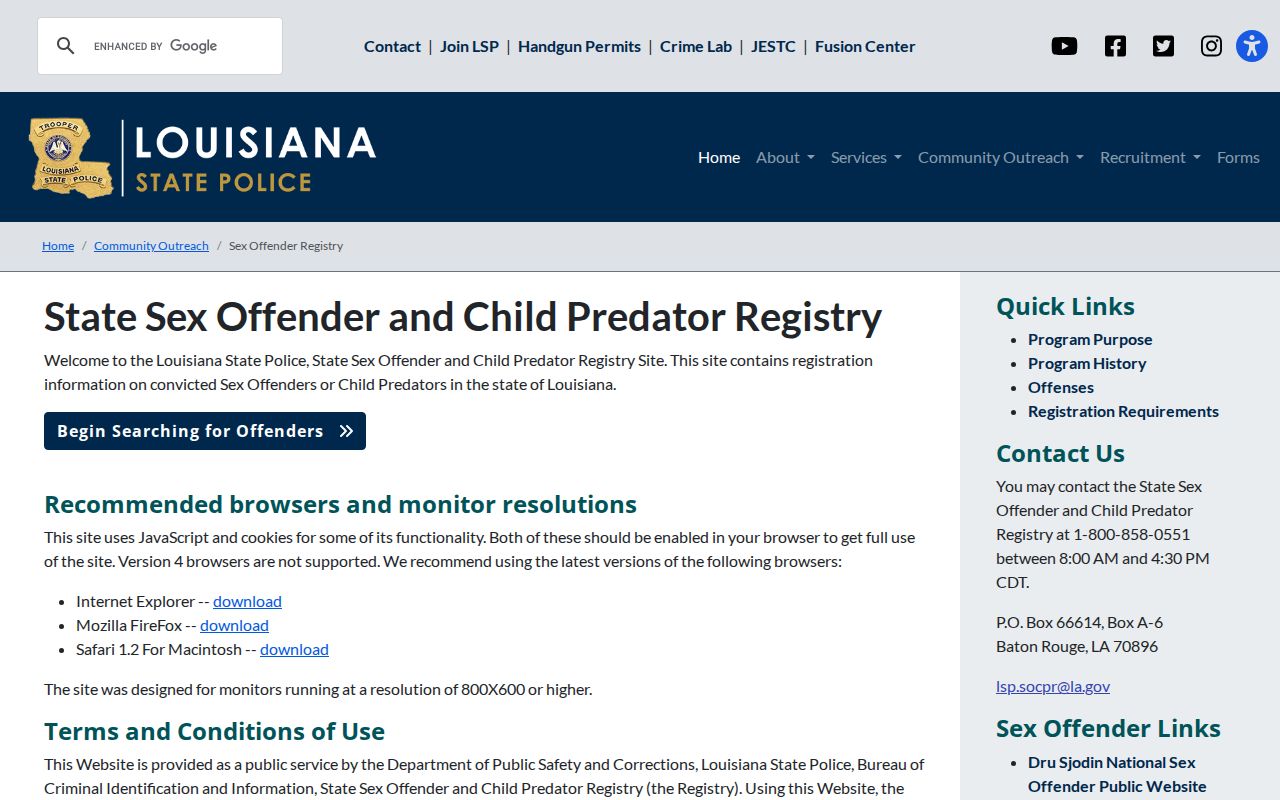
This gateway frames the tool correctly: it supports community awareness and careful verification, not confrontation or punishment.
Louisiana State Sex Offender and Child Predator Registry Searches
The Louisiana State Sex Offender and Child Predator Registry search supports name and location-based approaches. A parish filter helps isolate East Baton Rouge results; an address and radius are better for neighborhood awareness. Map geocoding is imperfect, so compare a pin with the written address.
- Open the official registry and accept the conditions of use.
- Choose name search or enter an address, city, ZIP code, parish, and radius.
- Compare the result list by photograph, aliases, age, and physical details rather than name alone.
- Open the profile and review the offense, jurisdiction, address, registering agency, status, and verification dates.
| Field Label | Type | Required | Notes |
|---|---|---|---|
| Last Name | Text | Name mode | Test spelling variations and aliases. |
| First Name | Text | No | Narrows a common surname. |
| City / ZIP | Text or select | No | Use Baton Rouge, Central, Zachary, or a five-digit ZIP. |
| Parish | Select | No | Choose East Baton Rouge Parish. |
| Address / Radius | Text and dropdown | Proximity mode | Confirm the map pin against the displayed address. |
Name Search Versus Address Search
A name query tests whether a known person appears under that spelling. An address-radius query asks what registrations are reported around a place. The official Louisiana search screen shows why choosing the correct mode matters.
Neither mode proves present location by itself. Verify a result through the full profile and its registering agency, especially when names are shared or a map pin looks misplaced.
Registry Profiles: What They Show
A public profile assembles identity, appearance, location, offense, and registration data. Fields vary by person, and a blank field does not establish noncompliance. The registry profile interface demonstrates the layout without making a commercial aggregator the source.
Read the profile as a connected record: identifiers help confirm identity, while offense jurisdiction and registration dates explain why the entry appears.
| Name & Aliases | Primary name and alternate names supplied to the registry. |
|---|---|
| Photo & Physical Description | Current or prior images plus sex, race, height, weight, hair, eyes, and identifying marks when available. |
| Registered Address | Reported residential or location information; verify apparent errors with the registering agency. |
| Offense & Statute | Offense name, legal citation, jurisdiction, and conviction or adjudication information. |
| Duration | Louisiana’s offense-based 15-year, 25-year, or lifetime obligation rather than a public risk score. |
| Registration Status | Compliance status, registering agency, and registration or verification dates when displayed. |
What to Do When an Address Looks Wrong
Do not approach the person or household. First compare the written address, map location, photograph, identifiers, status, and most recent verification date. A stale photograph, missing address, or shifted geocode is not proof that someone violated the law.
Report a suspected error or noncompliance to the registering agency shown on the profile or call EBRSO at 225-389-5000 for routing. Emergencies go to 911. Qualifying anonymous tips may go to Crime Stoppers at 225-344-7867 or 1-877-723-7867.
Registration Levels and Duties in Louisiana
Louisiana Revised Statute 15:544 assigns offense-based periods; it does not publish a simple low, medium, or high risk grade. Later incarceration can restart a period under statutory conditions. Out-of-state registrants generally face the longer applicable period, and covered new residents must follow Louisiana’s prompt appearance rules.
| Level / Tier | Duration | Verification Frequency |
|---|---|---|
| Base covered offenses | 15 years | Set by statute and registering agency; a qualifying motion may reduce the period after ten clean years and treatment. |
| Minor-victim and assigned offenses | 25 years | Verification follows the statutory category and agency instructions. |
| Enumerated aggravated or repeat categories | Lifetime | Ongoing statutory verification; limited juvenile relief may be available by motion. |
A later incarceration can restart the applicable registration period under the statutory rules, and credit generally depends on Louisiana residence and compliance. A person arriving from another state may be subject to the longer of the originating jurisdiction’s period or Louisiana’s applicable period. Covered new Louisiana residents generally must appear and provide required information within three business days of establishing residence, subject to the detailed requirements and exceptions in R.S. 15:542. These rules are another reason not to infer a remaining term from the conviction date alone.
Use NSOPW When the Search Crosses Louisiana
East Baton Rouge sits amid interstate, university, industrial, and state-government movement. When the relevant person or address may cross a state line, the U.S. Department of Justice NSOPW search checks participating jurisdictions from one entry point.
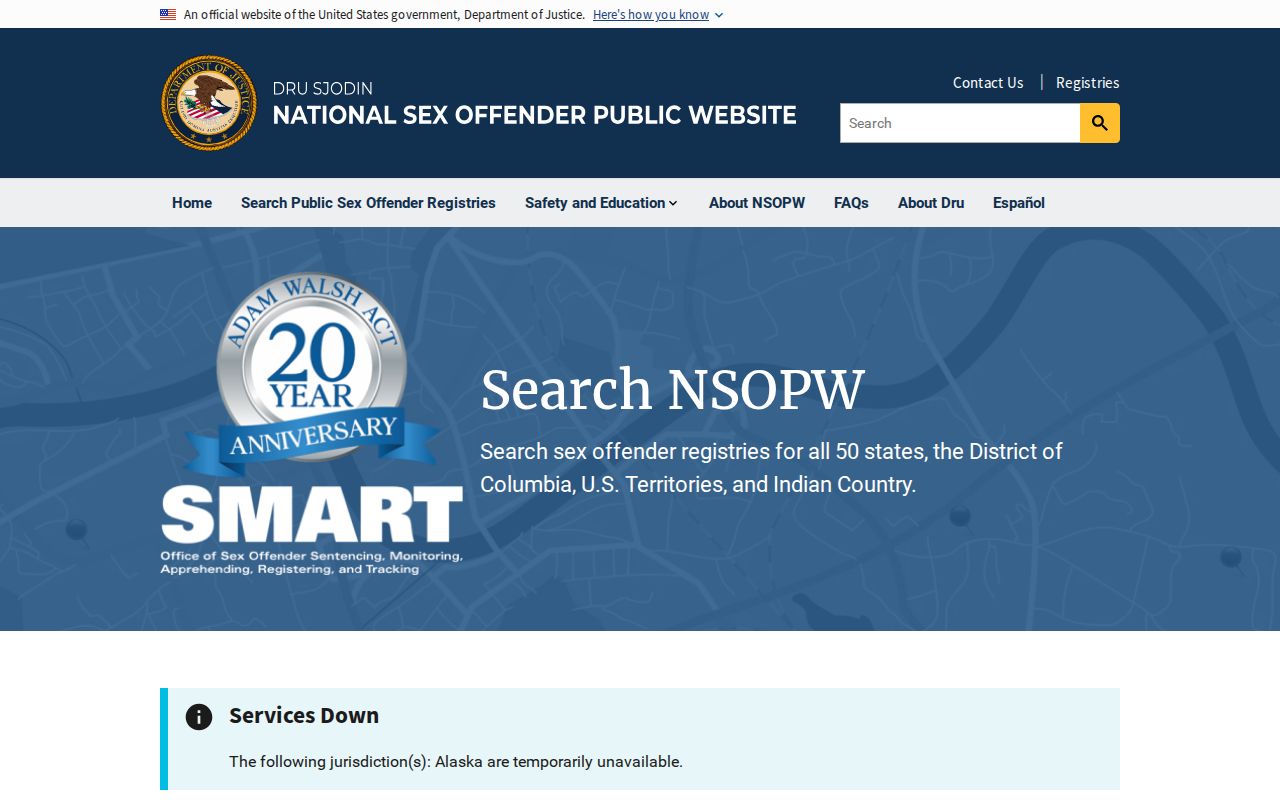
NSOPW broadens geographic coverage but does not replace the Louisiana profile. Follow a match back to its state source for current details and the proper correction channel.
Louisiana Registry Scores and SORNA
Louisiana’s public-facing periods are tied to statutory offense categories. Calling the 15-, 25-year, and lifetime groups “risk levels” can imply an assessment the state registry does not claim to make. The offense, date, jurisdiction, duration, and compliance fields should be reported as displayed without predicting conduct.
EBRSO and Municipal Police Handle Local Registration
Louisiana Revised Statute 15:542 assigns registration duties through the law-enforcement agencies specified by law. In East Baton Rouge Parish, that generally means the sheriff and, depending on the person’s residence, a municipal police agency. The agency named on a public profile is therefore important: it identifies the office best positioned to examine a questioned address, status, or verification date.
The public should call EBRSO at 225-389-5000 for the current registration-unit address, appointment procedure, office hours, required documents, and any applicable fees. The Parish Prison inmate-record desk serves a different purpose and should not be treated as the registration counter. A Baton Rouge, Central, or Zachary resident may be routed according to the municipal and statutory assignment that applies to the address.
The public registry remains the proper online search channel, while the registering agency handles suspected address errors or noncompliance. Emergencies belong with 911. Crime Stoppers accepts qualifying anonymous tips at 225-344-7867 or 1-877-723-7867, but an ordinary correction should go to EBRSO, municipal police, or the agency named on the profile. Providing the profile identifier, disputed field, and reason for concern gives the agency a clearer issue to verify than a general allegation.
Match More Than a Shared Name
A common name can produce several results. Compare the current photograph and any prior image, aliases, approximate age or date of birth, physical description, scars or tattoos when displayed, offense jurisdiction, and reported address. Vehicle, work, school, or secondary-location information may appear where Louisiana law requires it, but not every field is present on every profile.
Registration status and verification dates deserve separate attention. They describe what the registry currently reports; they do not independently establish where someone is at a particular moment. When identifiers conflict, record the profile details and contact the registering agency. Avoid circulating a screenshot that could misidentify another person after the official entry changes.
Using Registry Information Lawfully
The registry supports personal, family, neighborhood, and community safety planning. Alerts or proximity notifications may be used when the live portal offers them, but users should confirm the current trigger and radius. Information comes from multiple participants and may not reflect an immediate move or correction.
Use registry information responsibly: Louisiana’s registry is for public safety and awareness. It does not authorize vigilantism, harassment, threats, trespass, confrontation, or unlawful discrimination against a registrant or household. Registration duties and periods are governed by La. R.S. 15:542 and La. R.S. 15:544.