
Central Criminal History Checks
Identify whether the target is a Central PD report, crash report, parish booking, municipal citation, or district case. Each has a different custodian.
- Choose Central’s public-record form or separate crash route.
- Describe the Central PD event precisely.
- Contact Municipal Court for a city citation.
- Check EBRSO for booking and Court Case Lookup for district filing.
- Use BCII Right to Review for your own statewide record.
Central Splits Crash and Public Records
The official page presents ordinary public-record requests and crash reports as different routes. Sending a collision request into the general queue can delay it. A crash request commonly needs a party, crash date, location, report number, and contact details.
The Central records portal makes the split visible.
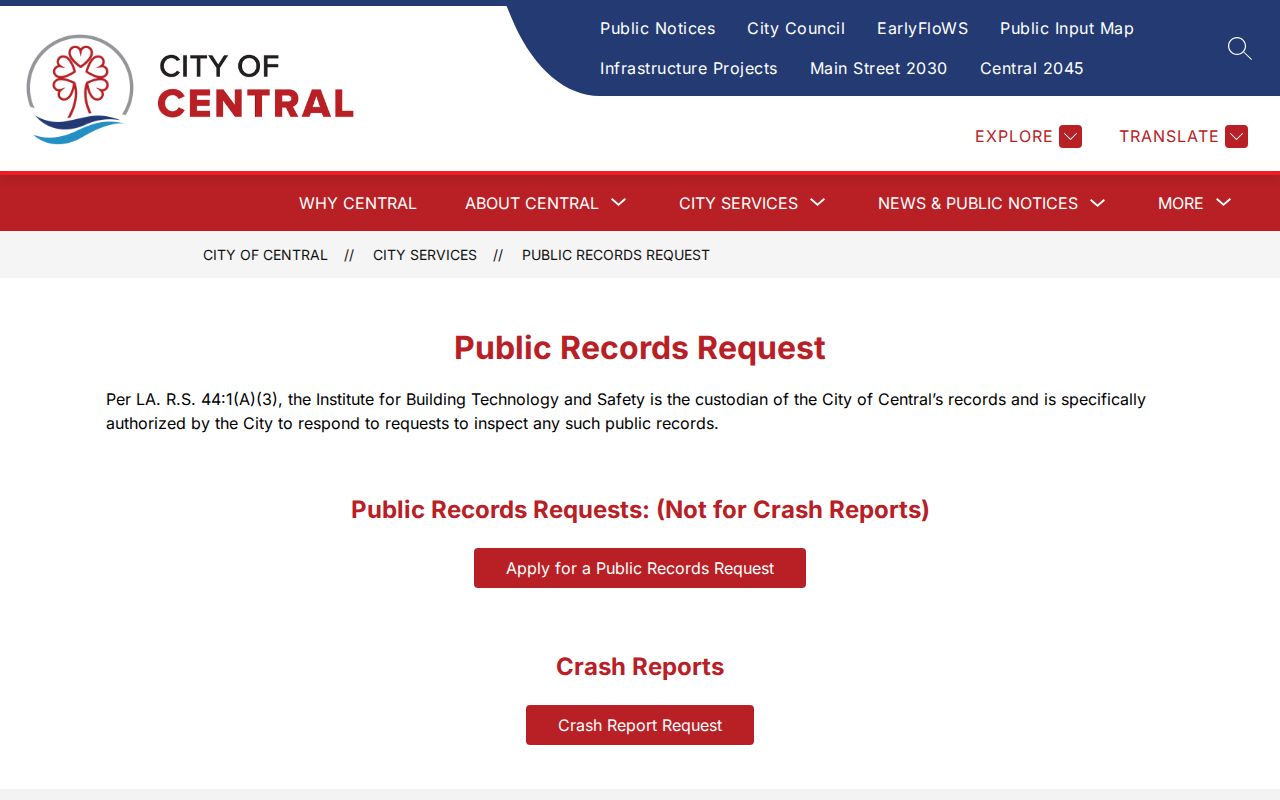
Select the route by record type before completing the live application.
Records at Central Police Department
Central PD creates the incident or arrest report. The city identifies IBTS as custodian under R.S. 44:1(A)(3). Forms may request contact details, department, record description, date range, delivery preference, attachments, and certification.
The official Central PD page is the agency starting point.
No verified app-only lookup was found; use official web and City Hall channels.
IBTS Keeps Central City Records
City Hall is at 11530 Sullivan Road, Central, LA 70818. Call 225-262-5000 or fax 225-246-8540 when the form does not fit the request. A narrow description helps IBTS identify the responsive department.
Booking and Arrest Records in Central
Central PD creates its arrest report, but custodial arrests generally flow to EBRSO Parish Prison. A booking documents custody, not conviction.
Use the EBRSO inmate list and call Inmate Records at 225-358-4000 when needed. Then request the Central report and follow filed charges to court through the Arrest Search process.
From Central PD to Parish Court
One event can create a Central PD report, an EBRSO booking, and a 19th JDC case if the district attorney files state charges. These systems use different identifiers and update separately. Search with incident date, report number, booking number, and case number as each becomes available.
The Central Municipal Court File
Municipal ordinance and traffic matters route through Central’s court. No verified comprehensive anonymous case database was found. Contact the court through the city or City Hall with the defendant name, citation or case number, citation date, and scheduled court date.
| Court Name | Central Municipal Court |
|---|---|
| Case Types Heard | Municipal ordinance and traffic matters. |
| Case Lookup Channel | City court contact or City Hall. |
| What to Request | Charge, status, next setting, balance, and disposition. |
| Copies & Fees | Ask the clerk about certified copies and current fees. |
Central Cases Split Between Two Courts
A city citation can stay in Municipal Court, while a state felony or district prosecution becomes a 19th JDC file. The arrest location does not select the court. Read the citation or charging notice and ask the named clerk before deciding that a case is missing.
How Central Records Reach the County
Recent activity begins with Central PD and IBTS. Custody is recorded by EBRSO. Municipal cases stay local; district cases go to 19th JDC. Reported dispositions should reach BCII.
Record flow: Central Police Department › East Baton Rouge Parish courts › Louisiana State Police BCII
Use each system for its own question and confirm conflicts with its custodian.
Central’s 2005 Records System
Central incorporated in 2005, making its municipal institutions newer than Baton Rouge City Court. Its suburban growth and separate police identity mean BRPD records do not cover Central incidents. Crime counts must use Central PD’s own FBI agency series and year, not a combined BRPD or EBRSO figure.
Describe a Central Record Precisely
The ordinary public-record application may collect the requester’s first and last name, email, phone, address or organization, a detailed record description, department, and a date or date range. It may also ask whether the requester wants inspection, copies, or electronic delivery, and can provide attachment, certification, and acknowledgment controls. The live application, not an old screenshot, determines which fields are mandatory.
A useful description distinguishes an incident report from a booking, citation, court file, or crash report. Include the Central PD report number when known, along with the exact location, event date, involved person, and the smallest practical range. For a collision, use the crash route and provide the driver or party, date, location, and report number. These details reduce the chance that IBTS routes the request to the wrong department.
Central Report Versus Parish Booking
The Central police report can include the incident number, date and time, location, officer, allegations, legal basis, property or evidence, and narrative subject to lawful redaction. The EBRSO booking instead records intake details such as the jacket number, booking photograph, fingerprints, arresting agency, listed charges, holds, bond, and release status. Neither record alone supplies the final court outcome.
If the inmate list has no result, call Inmate Records rather than assuming no arrest occurred. A person may have been released, transferred, entered under a spelling variation, handled confidentially, or never placed in custodial booking. When the district attorney files charges, obtain the 19th JDC case number and read the disposition. “Arrested for” should never be rewritten as “convicted of.”
When Central Has No Case Portal
No verified comprehensive anonymous municipal case database appeared in the inspected official sources. That makes the clerk or City Hall contact the primary lookup route, not a failure of the search. Provide the defendant name, citation or case number, citation date, scheduled court date, and date of birth only if the clerk asks for it. Request the charge, current status, next setting, balance, and disposition.
A certified copy is a separate request and may carry a fee. If the clerk identifies a district case rather than a municipal matter, move to the East Baton Rouge Clerk of Court. Conversely, the district portal’s failure to show a city citation does not mean the citation disappeared; it may never have belonged to the 19th JDC.
Central Crime Data Needs an Agency Label
Central’s independent police identity matters for statistics as well as reports. Official crime data should be filtered to Central Police Department and identified by reporting year and metric. BRPD numbers describe Baton Rouge city reporting; EBRSO numbers reflect sheriff coverage and functions. Combining them without accounting for jurisdiction, reporting status, campus agencies, and overlap creates a figure that no single agency actually reported.
Arrests, reported offenses, jail bookings, accepted prosecutions, and disposed cases also measure different stages. Use FBI Crime Data Explorer for the police-reported series and the actual court or prosecutor source for case flow. A trend in one series should not be presented as a count from another.
Correct a Central Record at Its Source
A disputed police narrative belongs with Central PD and IBTS; a booking field belongs with EBRSO; a municipal docket belongs with the city court; and a district disposition belongs with the East Baton Rouge Clerk. For a person’s own statewide fingerprint-supported history, Louisiana State Police BCII offers Right to Review. The supporting disposition or agency document should accompany a correction request whenever possible.
A dismissal, refusal, or acquittal does not automatically erase every arrest record. Louisiana expungement can remove qualifying material from public access after a court order, but does not destroy the record or block every authorized justice-agency use. Current law and the official case file control eligibility.
Get Central’s Final Court Disposition
A police report records allegations and investigative facts; it does not certify how a prosecution ended. A booking likewise records custody and the charges listed at intake. For a Central municipal citation, ask the municipal clerk for the disposition and whether a certified copy is available. For a district prosecution, request the final docket and certified disposition from the East Baton Rouge Clerk of Court.
Provide the case or citation number, defendant name, approximate date, and court setting or division when known. Ask whether the record shows amendments, dismissal, plea, trial result, sentence, and later orders. A case can change after the first setting, so a calendar or balance screen should not be treated as the complete history.
Confirm Central Bench Warrants With Municipal Court
Central does not share Baton Rouge City Court’s open warrant dataset. A bench warrant connected to a Central municipal matter should be checked with Central Municipal Court through the current city channel. District arrest or capias information may instead require the 19th JDC clerk or EBRSO. Do not use the Baton Rouge dataset as if it covered every city in the parish.
A bench warrant can follow a missed appearance, failure to comply or pay, contempt, or an alleged probation violation. Obtain the correct case number and issuing court, then ask the clerk or counsel about the proper appearance, recall, payment, or bond process. Avoid approaching law enforcement based on stale or secondhand information.
Central Record Access Rules
Louisiana Public Records Law permits inspection from the proper custodian subject to active-investigation, juvenile, victim, sealed, expunged, and privacy restrictions. Arrest is not conviction; confirm the disposition.
Key Statutes:
Louisiana R.S. 44:31 - establishes general access.
Louisiana R.S. 44:32 - governs inspection and copies.
Louisiana C.Cr.P. art. 971 - explains expungement’s public-access effect.